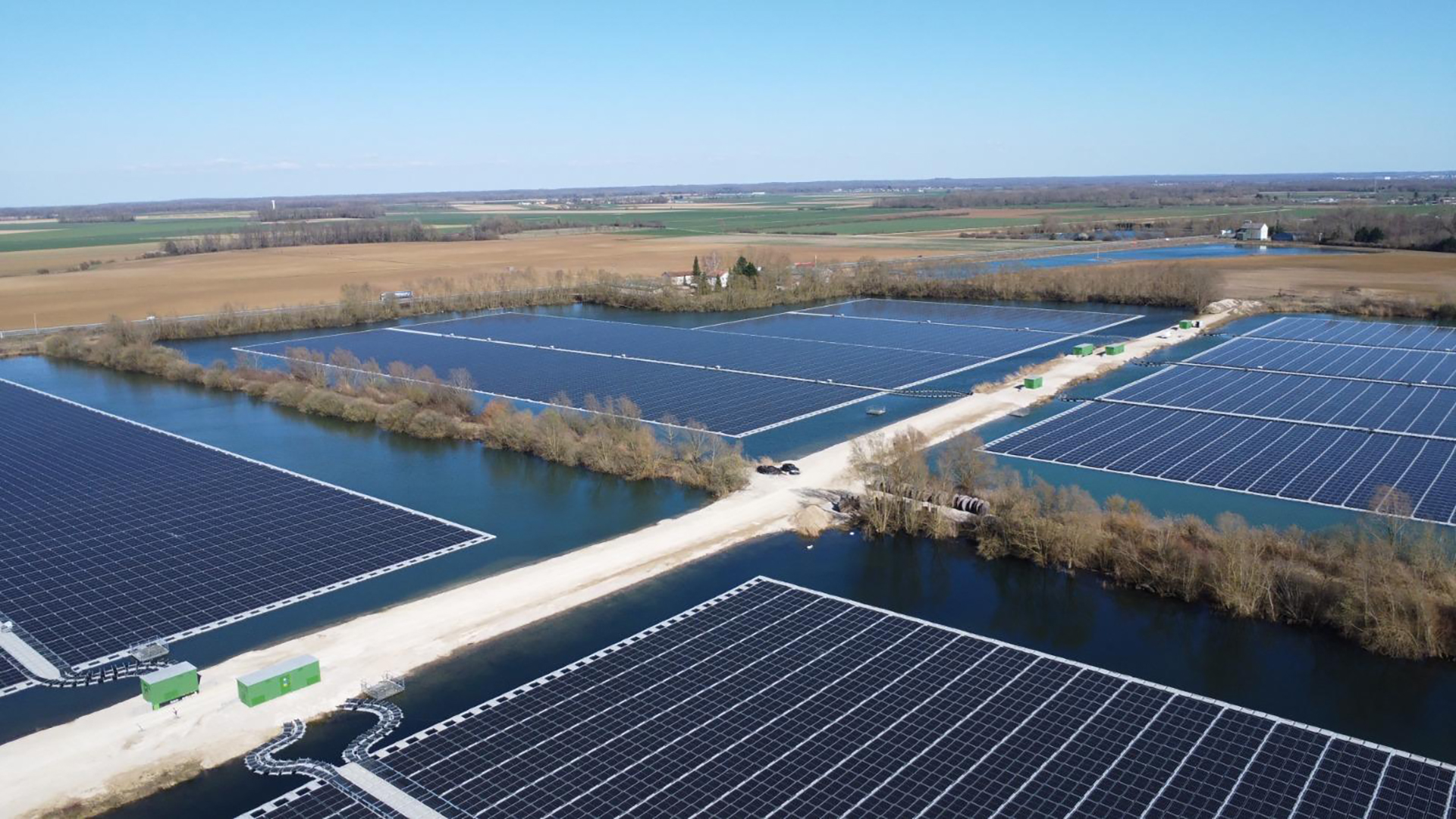
Les Îlots Blandin
Europe’s largest floating solar installation
Europe's largest floating solar, circular land use at scale
A 74 MWp floating and ground-mounted PV installation built across six former gravel lakes, transforming industrial land into large-scale renewable infrastructure.
Project Overview
After six years of development, Les Îlots Blandin proves that legacy industrial sites can be given a second life as productive clean energy assets. The former gravel pits in Perthes now host 135,000 solar modules floating across 127 hectares of water, generating enough electricity to power 18,000 homes while actively improving the aquatic ecosystem by reducing evaporation and limiting algae growth.
The Challenge
Transforming former gravel extraction basins into Europe's largest floating solar plant, navigating six years of complex environmental permitting, water body regulations, and innovative anchoring engineering across 127 hectares of open water.
Our Solution
PerPetum delivered a 74 MWp floating photovoltaic installation with 135,000 modules, complemented by a 2 MW ground-mounted array. Specialised anchoring and mooring systems were engineered for deep water bodies, while the floating design actively reduces water evaporation and algae growth, creating environmental co-benefits beyond clean energy.
- 74 MWp floating photovoltaic installation
- 135,000 solar modules across 127 hectares
- Complementary 2 MW ground-mounted array
- Specialised deep-water anchoring and mooring systems
- Reduced water evaporation and algae growth
- Circular land use: extraction basin to energy asset
Constructed and operated by PerPetum, transforming what was once an extraction basin into a European landmark for renewable energy.
Project highlights
Results & Impact
Les Îlots Blandin generates approximately 85,000 MWh of clean electricity per year, enough to power 18,000 French homes, while avoiding 18,000 tonnes of CO₂ annually. The floating design delivers environmental co-benefits: reduced water evaporation protects local water tables, while limited sunlight penetration controls algae proliferation. The project demonstrates that circular land use, repurposing extraction sites for clean energy, can deliver utility-scale impact without consuming a single hectare of productive land.