"
Four ways battery storage changes the economics for industrial companies.
Management summary
Solar PV is now the most cost-competitive source of electricity available. But solar alone solves only half the cost problem: it reduces what you pay during midday hours when the panels produce. The other half, the very high prices your site pays during morning and evening peaks when the sun is not shining, remains entirely intact without storage. A Battery Energy Storage System (BESS), integrated with on-site generation, addresses that second half through four distinct value streams: maximising on-site consumption of every kilowatt-hour you generate, capturing the daily price spread through arbitrage, reducing peak loads and related demand charges, and strengthening site resilience against grid constraints. Together, these streams deliver energy cost reductions of 20 to 60% for industrial companies. And through an Energy-as-a-Service structure, no upfront capital is required.
Solar alone solves only half the problem
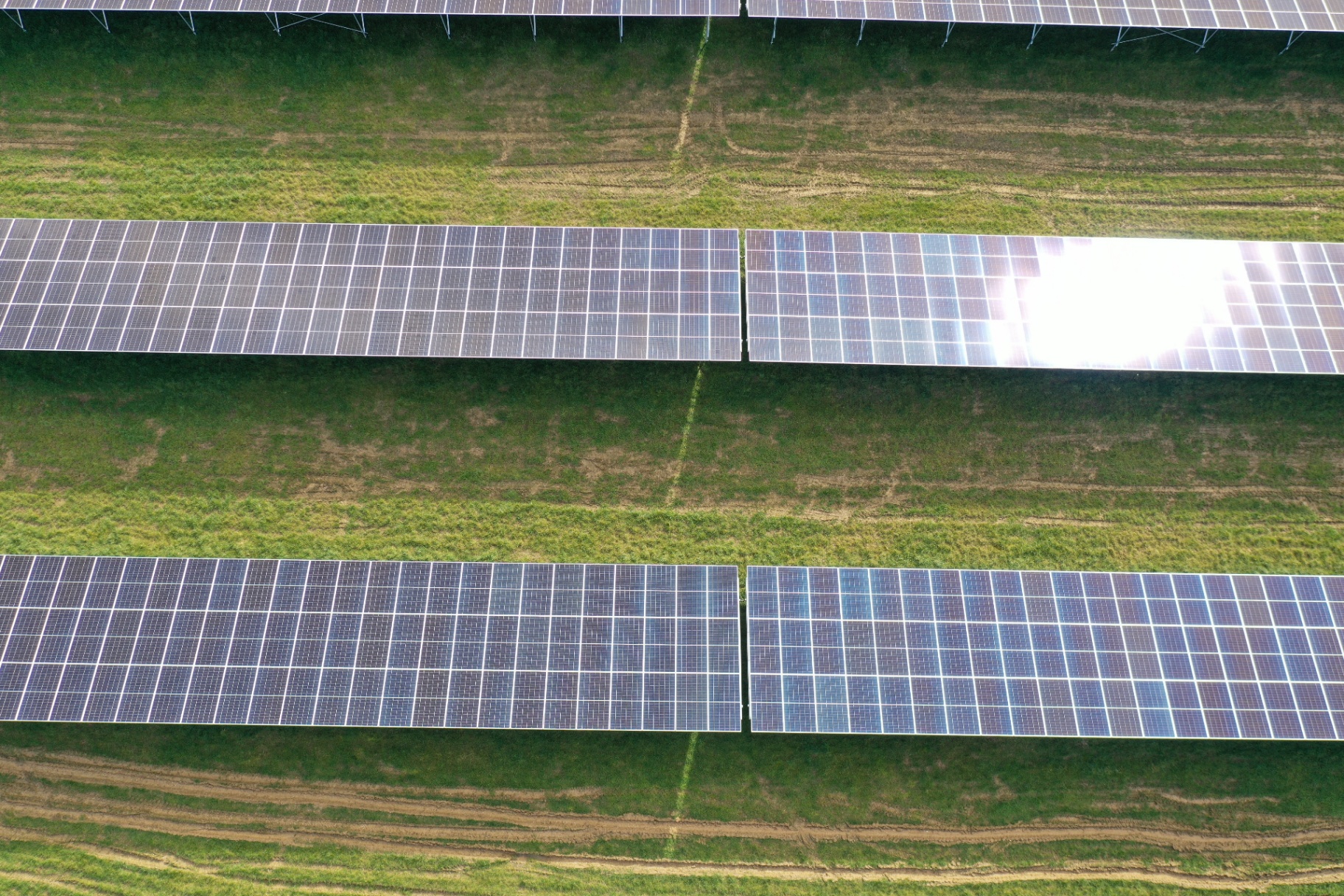
Solar PV has become the most cost-competitive source of renewable electricity available. According to IRENA's 2024 LCOE (Levelized Cost of Electricity) data, solar and onshore wind now have the lowest generation cost of any renewable energy source. The case for putting panels on a roof or on available land is financially straightforward.
But solar generates when the sun shines. Industrial demand does not follow that pattern. Factories run on production schedules. Process heat runs continuously. The mismatch between when solar produces cheaply and when the site consumes heavily is the structural cost problem that procurement contracts and hedging can reduce but cannot eliminate.
In Belgium, the gap between the cheapest and most expensive hours regularly reaches EUR 128/MWh. In Germany it averaged EUR 130/MWh across all of 2025 (FfE/EPEX Spot). A company that only looks at the solar side of that equation is solving the easier half of the problem.
Belgium is not an outlier. The same dynamics are reshaping energy markets across Europe.
Four value streams that change the economics
A well-configured BESS, integrated with on-site generation assets like solar PV, creates financial value through four distinct streams. Together, they are significantly more valuable than any one of them in isolation.
1. Maximise on-site consumption of every kilowatt-hour you generate
When solar production exceeds on-site demand, the surplus would normally be exported at low or negative prices. A BESS stores that surplus and deploys it during evening peaks, directly displacing the most expensive grid electricity the site would otherwise buy. At a daily spread of EUR 130/MWh, that shift produces a material and recurring saving. Beyond the price spread, every kilowatt-hour consumed from on-site generation or from a BESS charged from your own solar avoids the full stack of network charges, distribution fees and energy taxes. For large industrial consumers in Belgium, this behind-the-meter advantage typically represents more than 40% of the total energy invoice. It is structural, not market-dependent.
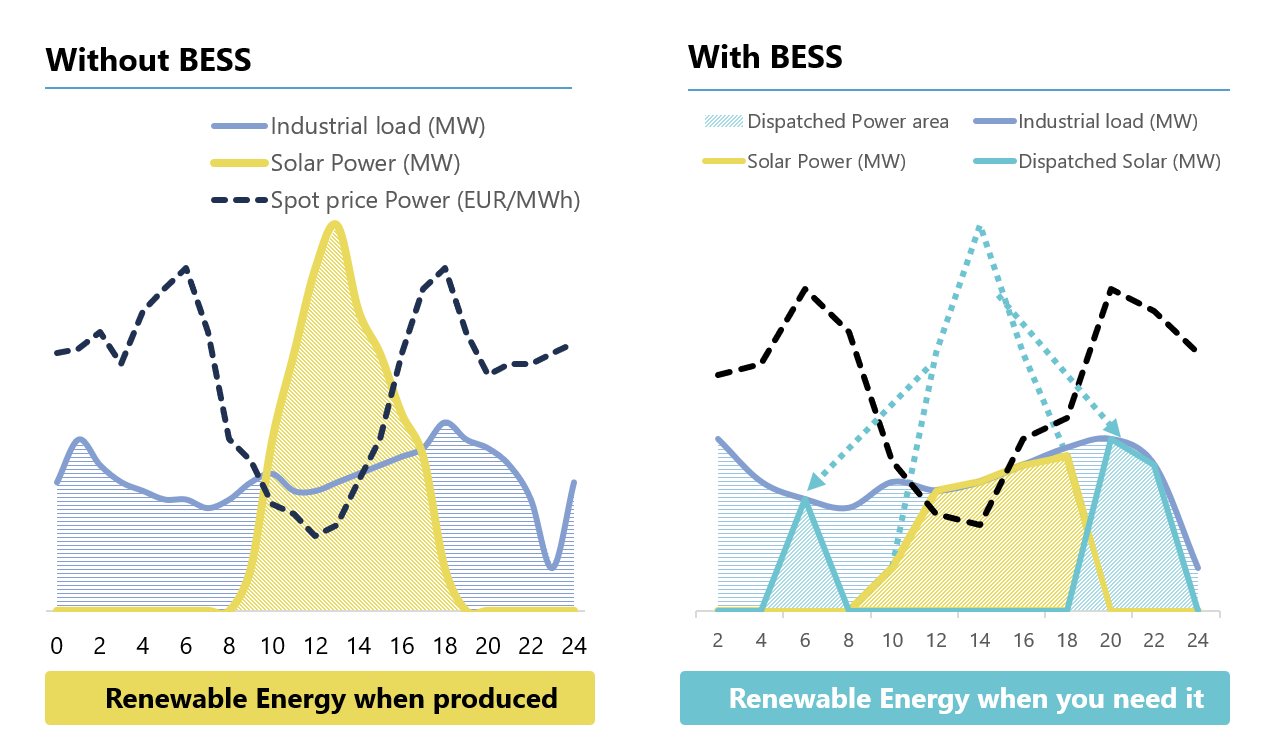
BESS makes renewable energy available 24/7 for use in timeslots with high financial value.
2. Buy cheap grid electricity and deploy it at peak
This is the stream that makes a BESS valuable year-round, regardless of solar conditions. The EMS (Energy Management System) reads the next day's day-ahead prices, charges the battery when electricity is cheapest, and deploys it during the morning and evening peaks. On a winter day when overnight prices are EUR 20/MWh and the evening peak reaches EUR 150/MWh, the BESS captures that EUR 130/MWh spread as a direct reduction in what the site pays. No sun needed.
3. Reduce peak loads and related demand charges
In most industrial tariff structures, a significant share of the grid invoice is determined by peak demand measurements, not just consumption volume. An EMS continuously monitors the site's load profile and dispatches the BESS to shave those peaks before they register, directly reducing the capacity component of the bill. As tariffs increasingly shift toward capacity-based pricing, this stream grows in value. In Flanders, medium-voltage distribution tariffs for businesses rose by an average of 39% in 2025 (source: VREG, December 2024). Grid fees in Germany have risen by more than 50% since 2021 (source: enspired/Bundesnetzagentur data, 2025). Peak management compounds in value as those tariffs continue to climb.
4. Site resilience and operational continuity
As electrification accelerates, connection capacity limits are becoming a structural constraint for industrial sites across Belgium, the Netherlands, Germany and France. A behind-the-meter BESS reduces net grid draw, allowing sites to electrify further processes without requiring a heavier grid connection, and to continue operating productively under congested conditions. For sites with ambitious electrification roadmaps, that capacity headroom has increasing strategic and financial value.
“A battery does not just store surplus solar. It turns the daily price spread into a recurring financial advantage, every day of the year.”
The EMS: configured around your objectives, not a generic algorithm
The four streams above do not operate independently. An Energy Management System coordinates them continuously, dispatching assets every 15 minutes based on production forecasts, price signals and the site's real-time consumption profile.
What distinguishes a well-implemented EMS is that the dispatch logic is configured around the company's own objectives. A site focused on cost reduction optimises for price spread capture and peak charge avoidance. A site focused on energy autonomy maximises self-consumption and minimises grid dependency. A site with strong decarbonisation commitments prioritises on-site renewable consumption and electrification of heat. The EMS does not define the strategy. It executes it, precisely and continuously.
What this means for your energy bill
Companies that have deployed integrated PV and BESS systems behind the meter report energy cost reductions of 20 to 60%, depending on site configuration, consumption profile and market exposure.
The business case also extends beyond electricity. When a BESS provides reliable, dispatchable electricity, it enables the progressive electrification of heat, replacing gas-fired boilers with e-boilers or heat pumps. As ETS2 adds carbon costs to natural gas from 2028 onwards, that financial case strengthens further.
Zero capital required
Under an Energy-as-a-Service structure, a specialist partner designs, finances, builds and operates the full system. The client pays a service fee and, in return, benefits from significant direct savings on energy costs from the first month of operation, while being protected against rising prices. No upfront investment. No technology risk on the balance sheet.
For a CFO, the relevant question is not what the installation costs. It is whether the service fee is lower than the bill it replaces from day one. And as grid fees rise, carbon costs increase and price spreads widen, that answer only improves over time.
Curious what this could mean for your site's energy bill? Let us analyse your load profile and build the business case together.
Sources
-
IRENA 2024 Year in Review: Climate-driven Global Renewable Energy Resources and Energy Demand, January 2026. 2024 Year in Review: Climate-driven Global Renewable Energy Resources and Energy Demand
-
FfE/EPEX Spot European day-ahead electricity prices in 2024, January 2026. ffe.de/en/publications/european-day-ahead-electricity-prices-in-2024/
-
VREG distribution network tariffs 2025, December 2024. VREG keurt distributienettarieven 2025 goed | EMIS
-
Gridio 2025 Electricity Prices Belgium, December 2025. 🇧🇪 2025 Electricity Prices: 5 Insights for Belgian EV Drivers
-
enspired/Bundesnetzagentur grid fee analysis Germany, 2025. Grid fees in Germany
-
Elia Summer Outlook 2026, March 2026. Elia Summer Outlook 2026: need for extra flexibility remains high
-
European Commission ETS2 official documentation. About the EU ETS - Climate Action - European Commission
"